
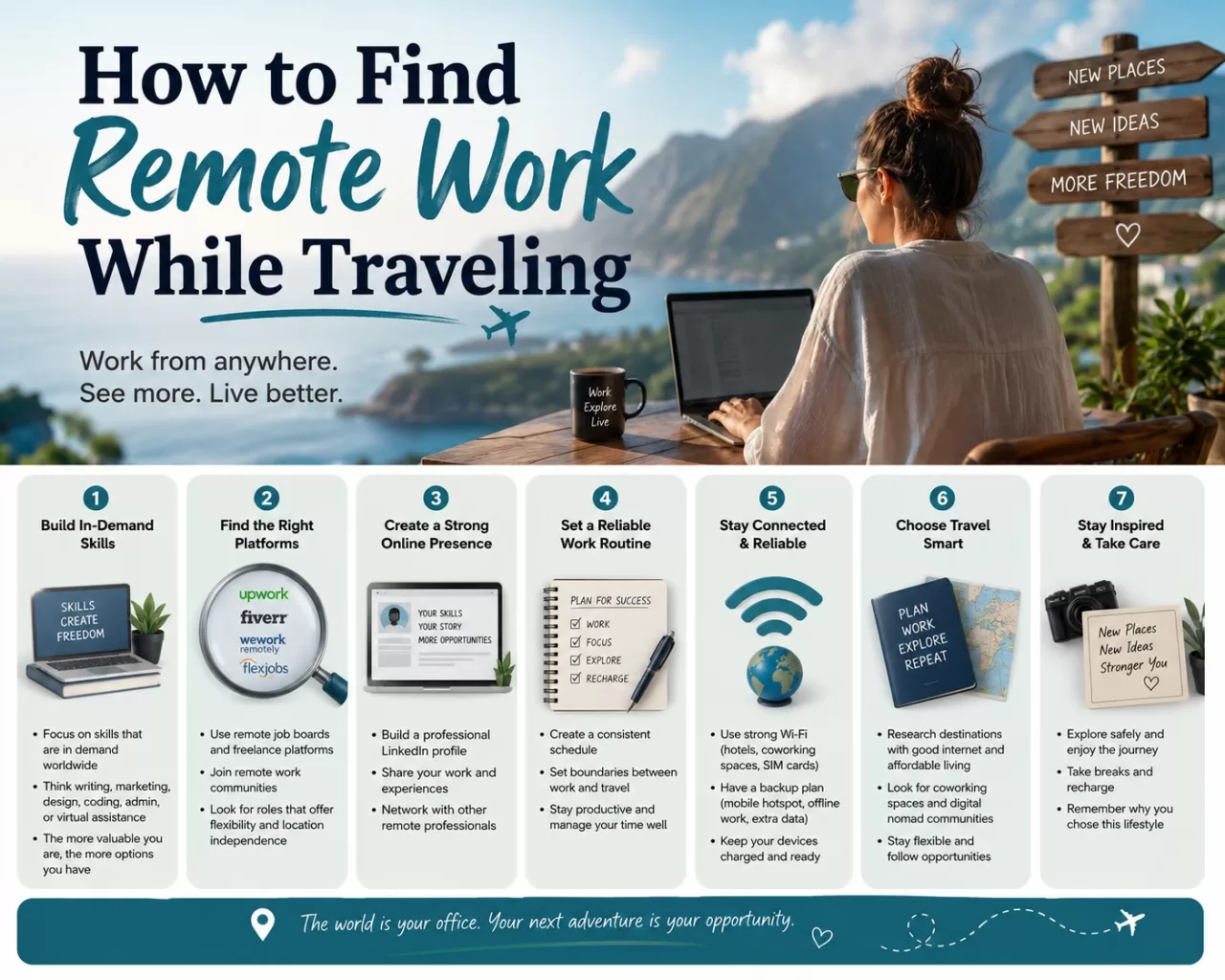
Finding remote work that actually supports long-term travel is different from finding any remote job. Time zone flexibility, reliable income during transition periods, and work that doesn't require a fixed physical presence all matter more here than they would for someone working remotely from a single home base. The paths below cover the main routes people actually use to make this work.
▤ Contents⌃
- 1Negotiate Remote Work With a Current Employer First
- 2Look for Remote-First Job Boards
- 3Build Freelance Income Through Established Platforms
- 4Focus on Skills That Convert Well to Remote Work
- 5Diversify Income Rather Than Relying on One Client or Platform
- 6Use Networking Platforms Actively, Not Passively
- 7Consider Remote Staffing Agencies
- 8Account for Time Zones Before Committing to a Destination
- 9Set Up a Workspace That Supports Consistent Output
- 10Track Income Against a Real Budget, Not an Optimistic One
- 11Understand Tax Implications Before They Become a Problem
- 12Lean on Existing Nomad Communities for Leads
- 13Common Paths Into Remote Work, Compared
- 14Frequently Asked Questions
- 15Making Remote Work Sustainable, Not Just Possible
Negotiate Remote Work With a Current Employer First
Before looking elsewhere, it's worth checking whether an existing job can simply become remote, either fully or on a trial basis. This is usually the lowest-risk path into remote work, since it preserves existing income and benefits while removing the physical office requirement. Framing the request around specific, demonstrated productivity — rather than a general preference for flexibility — tends to get a more favorable response from employers still deciding on remote work policies.
Look for Remote-First Job Boards
General job boards often bury remote listings among location-specific ones, while dedicated remote job boards filter for this by default. Sites built specifically around remote roles — including options like We Work Remotely, Remote.co, and FlexJobs — tend to surface higher-quality listings than searching "remote" on a general job site, since companies posting there are already committed to remote hiring rather than making an exception.
Build Freelance Income Through Established Platforms
Freelance platforms like Upwork, Fiverr, and Toptal offer a starting point for building remote income, particularly for skills like writing, design, development, and virtual assistance. Income through these platforms is typically inconsistent in the first few months, which is why building freelance income before fully committing to travel — rather than starting from zero after already leaving — reduces financial risk considerably. Specific strategies for building this income base are covered in how to build a remote career that lets you travel.
Focus on Skills That Convert Well to Remote Work
Not every skill translates equally well into remote income. Writing, editing, graphic design, web development, digital marketing, virtual assistance, translation, and consulting all have well-established remote markets with consistent demand. Skills requiring physical presence or highly synchronous collaboration tend to convert less easily, though even these fields often have remote-adjacent roles (project management, client-facing coordination) worth considering as an entry point.
Diversify Income Rather Than Relying on One Client or Platform
Relying on a single client or a single platform for all income creates risk that's amplified while traveling, since resolving a lost client or platform issue is harder without a stable home base to fall back on. Spreading income across a few clients, or combining freelance platform work with direct client relationships, provides more stability if one income source slows down or disappears.
Use Networking Platforms Actively, Not Passively
LinkedIn and industry-specific communities remain effective for finding remote opportunities, but passively maintaining a profile rarely generates leads on its own. Actively posting about relevant work, engaging with industry discussions, and directly reaching out to companies with recent remote job postings tends to produce far more opportunities than waiting to be found.
Consider Remote Staffing Agencies
Staffing and recruitment agencies specializing in remote placements can be a useful shortcut, particularly for roles in customer support, virtual assistance, and administrative work, where demand for remote workers is consistently high. These agencies handle much of the vetting and matching process, which can save considerable time compared to applying individually to postings.
Account for Time Zones Before Committing to a Destination
Time zone alignment with existing or target clients affects both income stability and daily quality of life more than most people expect before actually traveling. Working significantly out of sync with clients or an employer's core hours can mean odd working hours, delayed communication, and general friction that's avoidable by choosing destinations with better overlap. This is one of the practical factors worth weighing alongside cost of living when picking a base, covered in more detail in best cities for digital nomads on a budget.
Set Up a Workspace That Supports Consistent Output
Reliable internet and a workable desk setup matter more for maintaining client relationships and job performance than most new remote workers initially plan for. Coworking spaces solve this directly and also provide a natural way to meet other remote workers, which helps both professionally and socially. A list of coworking spaces known for genuinely supporting long-term remote work is in best coworking spaces for remote workers abroad.
Track Income Against a Real Budget, Not an Optimistic One
Freelance and remote income tends to fluctuate month to month, especially in the first year. Budgeting against a conservative estimate — rather than an average or best-case month — avoids the common mistake of overspending during a strong month and then struggling during a slower one. How to structure a sustainable long-term travel budget around this kind of income variability is covered in how to travel long-term without running out of money.
Understand Tax Implications Before They Become a Problem
Remote income earned while traveling still has tax implications, which depend on citizenship, time spent in each country, and various tax treaties. This is frequently overlooked until it becomes an issue, and getting professional advice early is generally cheaper than fixing a mistake later. A general overview of how this works is in digital nomad taxes: what you need to know.
Lean on Existing Nomad Communities for Leads
Online communities and forums built around remote work and digital nomad life frequently share job leads, freelance opportunities, and direct referrals that don't appear on general job boards. These communities are also a reliable source of practical, current advice on which platforms and approaches are actually working for other people right now. Where to find active, useful communities is covered in digital nomad communities: where to find them.
Common Paths Into Remote Work, Compared
| Path | Time to Reliable Income | Best Suited For |
|---|---|---|
| Negotiating with current employer | Fast, often immediate | Anyone with an existing job that could plausibly go remote |
| Remote job boards | Weeks to a few months | People seeking a traditional employee role, with benefits |
| Freelance platforms | A few months to build momentum | People with a marketable skill and tolerance for inconsistent early income |
| Staffing agencies | Weeks to a couple months | Customer support, admin, and similarly high-demand remote roles |
Frequently Asked Questions
Is it realistic to find remote work after already starting to travel?
It's possible, but riskier than securing income before leaving. Building at least some reliable income or savings buffer beforehand reduces the financial pressure of job hunting while also managing the logistics of travel.
What's the fastest way to start earning remotely?
Negotiating remote status with an existing employer is typically the fastest path, since it doesn't require building a new client base or job search from scratch. Freelance platforms can generate income relatively quickly too, though usually at lower and less consistent rates initially.
Do employers care where a remote employee is physically located?
Often yes, for tax, legal, and time zone reasons, even in fully remote roles. It's worth clarifying this directly with an employer before assuming complete geographic freedom, since some companies restrict remote work to specific countries or regions.
Making Remote Work Sustainable, Not Just Possible
Finding remote work is the first hurdle; keeping it stable while traveling is the ongoing one. Diversifying income, planning around time zones, and maintaining a genuine workspace setup all matter more once travel is actually underway than they do during the initial job search. The goal isn't just finding remote work once — it's building a setup that holds up across multiple destinations and the inevitable disruptions that come with moving around regularly.




Comments 0