
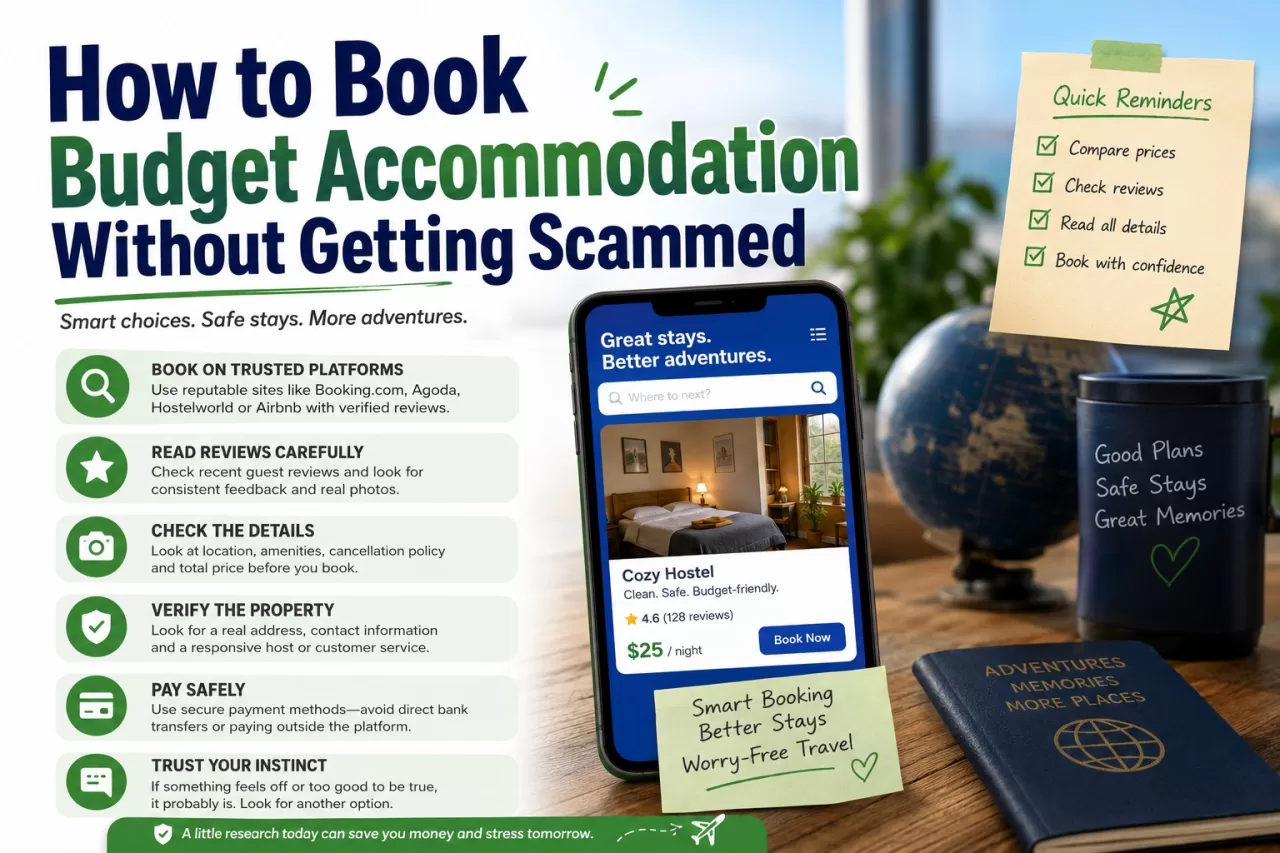
Accommodation scams tend to follow a small number of repeatable patterns, which makes them fairly easy to spot once the warning signs are known. Most of the risk comes from stepping outside established, buyer-protected platforms in search of a slightly better price — which is exactly where most scams are designed to intercept travelers looking for a deal.
▤ Contents⌃
- 1Common Scam Patterns to Watch For
- 2Stick to Established Platforms With Buyer Protection
- 3Never Pay Outside the Platform
- 4Read Reviews for Patterns, Not Just Star Ratings
- 5Check for a Verifiable Address and Location
- 6Use Reverse Image Search on Suspicious Listings
- 7Contact the Host Before Booking, If Something Feels Off
- 8Check the Cancellation Policy Before Committing
- 9Be Cautious With Listings That Seem Too Good for the Area
- 10Different Accommodation Types, Different Risks
- 11What to Do If a Booking Turns Out to Be a Scam
- 12A Quick Pre-Booking Checklist
- 13Frequently Asked Questions
- 14Diligence Over Price Alone
Common Scam Patterns to Watch For
| Warning Sign | What It Usually Means |
|---|---|
| Price significantly below comparable listings nearby | Often a fake listing, a bait-and-switch, or a property that doesn't actually exist |
| Host asks to pay outside the booking platform | Removes any buyer protection; a strong indicator of a scam |
| Only very recent reviews, all glowing and similarly worded | Possible fake reviews, sometimes paired with a recently created or renamed listing |
| No verified address or exact location shown only after booking | Common tactic to prevent verification before payment is made |
| Urgency tactics ("only one room left, book in the next 10 minutes") | Designed to prevent the kind of careful checking that would reveal a problem |
Stick to Established Platforms With Buyer Protection
Booking through well-known, established platforms — rather than a listing found through a random link, social media ad, or an unfamiliar website — provides a meaningful layer of protection, since these platforms typically offer refunds or support if a listing turns out to be fraudulent or significantly misrepresented. This doesn't make every listing on a major platform automatically safe, but it does mean there's recourse if something goes wrong, which usually doesn't exist with an off-platform booking.
Never Pay Outside the Platform
A host asking for payment via bank transfer, a payment app, or cryptocurrency instead of the platform's own payment system is one of the clearest scam indicators available. Legitimate hosts have no reason to avoid a platform's payment processing, and the request itself is almost always designed specifically to move the transaction outside of any protection or recourse the platform would otherwise provide.
Read Reviews for Patterns, Not Just Star Ratings
A high average rating doesn't guarantee a listing is safe or accurately represented, particularly if most reviews are old or if there's a sudden cluster of very recent, similarly worded five-star reviews. Reading a handful of the most recent reviews in detail, rather than relying on the overall score, reveals far more about current conditions and whether reviews look organic or manufactured.
Check for a Verifiable Address and Location
Legitimate listings on established platforms typically show an approximate or exact location on a map before booking. A listing that withholds the exact address until after payment, or one where the shown location doesn't match reviewer comments about the neighborhood, is worth treating with suspicion. Cross-checking the address or general area against a separate map search, when possible, adds another layer of verification.
Use Reverse Image Search on Suspicious Listings
Scam listings frequently reuse photos taken from other properties or stock photo sources. A reverse image search on a listing's main photos can reveal whether the same images appear elsewhere under a different property name or location, which is one of the more reliable ways to catch a fabricated listing before booking.
Contact the Host Before Booking, If Something Feels Off
A quick message to the host asking a specific, detail-oriented question (about the exact location, check-in process, or a small detail visible in the photos) often reveals a lot. Vague, delayed, or generic responses that don't actually address the question can indicate a fake or poorly-run listing, while a specific, prompt response is a reasonably good sign.
Check the Cancellation Policy Before Committing
Free cancellation up to a reasonable point before check-in provides flexibility if something about the booking turns out to be misrepresented once more information becomes available, or if a better option is found. Prioritizing this, even at a slightly higher price than a fully non-refundable option, is generally worth it for budget accommodation specifically, where the base research available is often thinner than for well-established hotel chains.
Be Cautious With Listings That Seem Too Good for the Area
A listing priced dramatically below comparable options in the same neighborhood is either an exceptional find or, more often, a red flag. Comparing a suspiciously cheap listing against several others nearby with similar amenities gives a reasonable baseline for what's actually realistic, and a large unexplained gap is worth treating with skepticism rather than excitement.
Different Accommodation Types, Different Risks
Hostels booked through established platforms are generally lower-risk, since they're physical, well-reviewed businesses with an ongoing reputation to maintain, rather than individual, one-off listings. A curated list of hostels known for being both social and reliably run is in best hostels for solo travelers around the world.
Vacation rentals and private listings carry more of the risks described above, simply because there's more variability in who's actually managing the property and how established the specific listing is. Extra diligence — reviews, verified address, platform payment — matters more here than for a well-known hostel or hotel chain.
Budget hotels generally carry lower scam risk than individual private listings, though it's still worth confirming a booking through a reputable platform rather than an unfamiliar third-party site claiming to offer a special rate.
What to Do If a Booking Turns Out to Be a Scam
If a booking is discovered to be fraudulent or significantly misrepresented, contacting the platform's support immediately — ideally before or immediately upon arrival, rather than after the stay — gives the best chance of a refund or rebooking assistance. Documenting the discrepancy with photos and keeping all communication with the host provides useful evidence if a dispute or refund claim is needed. Travel insurance can sometimes provide additional coverage for this kind of situation, and what to check for in a policy is covered in how to choose travel insurance for international trips.
A Quick Pre-Booking Checklist
- Booking through an established platform with buyer protection
- Payment processed through the platform, not requested outside of it
- Recent reviews checked in detail, not just the overall star rating
- Location verified or roughly cross-checked against a separate map
- Price compared against similar nearby listings to rule out an unrealistic deal
- Cancellation policy checked in case anything needs to change after booking
This fits naturally alongside the broader set of budget travel strategies covered in 15 budget travel tips that actually save you money and the foundational planning approach in how to travel on a budget: a complete beginner's guide.
Frequently Asked Questions
Is booking directly with a property always riskier than using a platform?
Generally yes, for budget or lesser-known accommodation specifically, since a platform provides a layer of buyer protection and review history that a direct, off-platform booking typically doesn't have.
How can you tell if reviews on a listing are fake?
Look for patterns: a cluster of very recent reviews with similar wording, an unusually high proportion of five-star ratings with little detail, or reviews that don't mention specific, verifiable details about the property.
What's the single most important thing to avoid when booking budget accommodation?
Never send payment outside the platform's own system, regardless of how convincing the request seems. This single practice removes almost all recourse if the booking turns out to be fraudulent.
Diligence Over Price Alone
The cheapest available listing isn't automatically the best deal if it turns out to be misrepresented or entirely fraudulent. A few extra minutes checking reviews, verifying location, and confirming payment goes through the platform itself consistently prevents the accommodation scams that catch travelers who prioritize price above every other signal.




Comments 0